
Moment Tensor Solution for the 22 Feb, 2015 Ml 4.2 Ramsgate, Kent earthquake
Data and Inversion ProcessWe used broadband waveforms from the British Geological Survey's seismometer network. For this earthquake, we used a total of 4 stations.
Waveforms were initially converted to displacement by removing instrument response and integration. We used the BGS hypocentre location (longitude = 1.409 W, latitude=51.283°N). The crustal model was based on the P-wave velocity model of Booth (2010) and a constant Vp/Vs ratio of 1.77, based on Tomlison et al. (2006). For the moment tensor inversion, we used the ISOLA software package (Sokos and Zahradnik, 2008), an interactive MATLAB-based GUI. We solve for for double-couple constrained moment tensor. The frequency band for the inversion was selected based on careful analysis of signal-to-noise ratio and the stations' epicentral distance. |

Map of BGS epicentre location (red star) and stations used for inversion (triangles).
|
Inversion for Moment Tensor and Centroid Depth
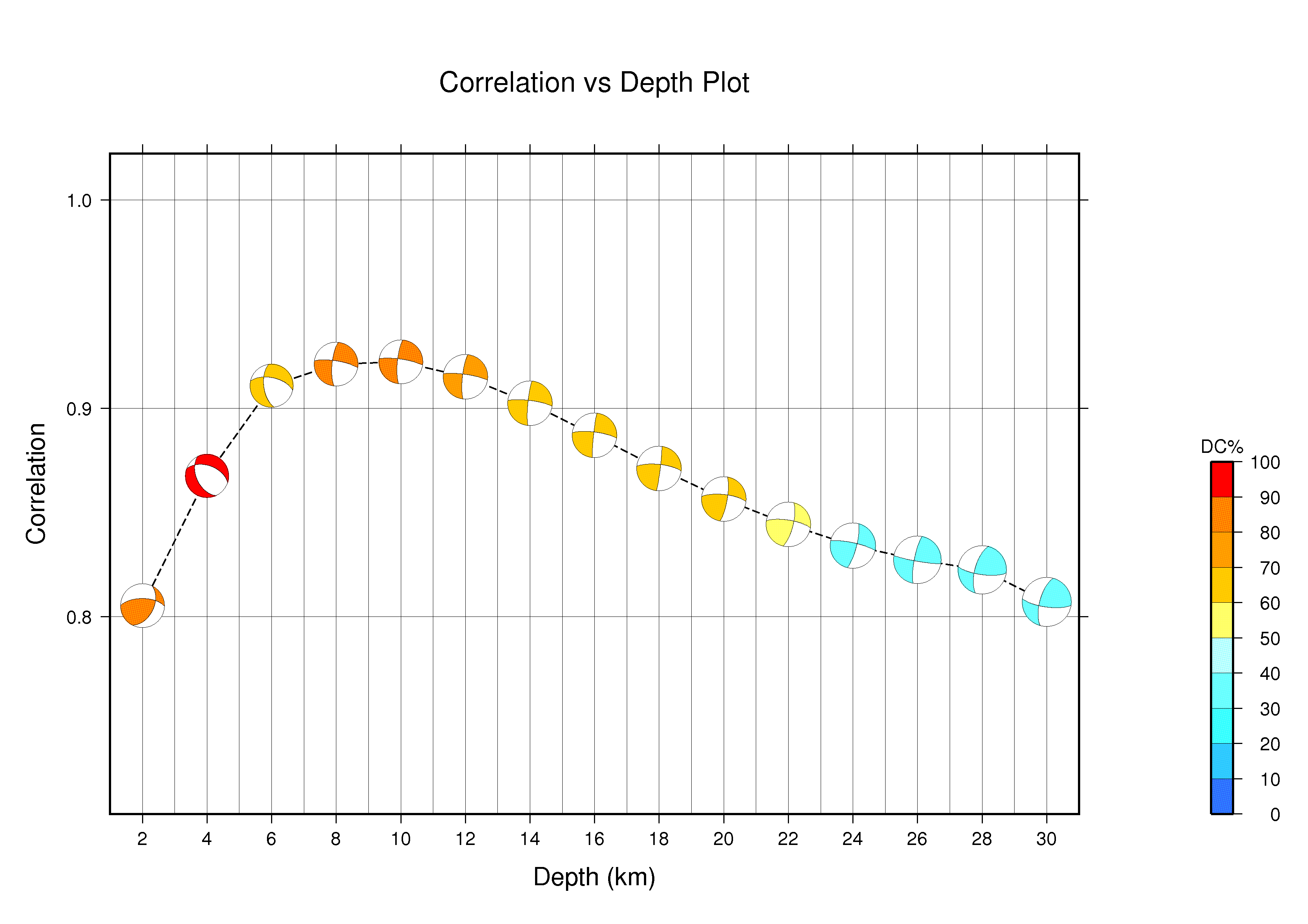
Correlation vs depth plot.
|
The depth of the centroid was found by keeping the epicentral coordinates fixed and by searching over a line of sources beneath the epicentre (5 - 27 km in steps of 2 km).
The highest correlation with the observed waveforms is found in the depth range 12 -22 km, over which the focal mechanism remains stable. The best correlation with the waveforms and highest percentage double couple is found at 17 km depth - this depth agrees well with the BGS hypocentre estimate of 15 km. A depth of 17 km produces a very good fit to the observed waveforms, as shown by the good variance reduction (0.62). |
Final Waveform Fits
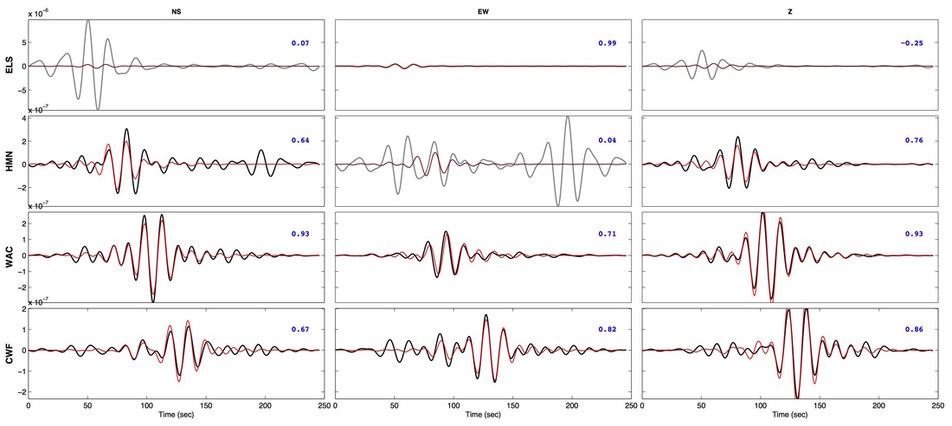
Comparison between synthetic (red) and observed (black) waveforms used in the inversion for the frequency range 0.03-0.08 Hz. Components not included in the inversion are greyed out. Variance reduction for each component is shown in blue. NS and Z components from station ELSH were not used due to near-field disturbances caused by the earthquake.
Best-fitting Solution
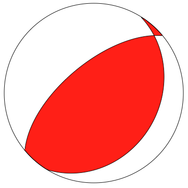
Focal mechanism of the best-fitting moment tensor solution
Technical parameters
Origin Time: 20150522 01:52:18.70 Centroid Time : +0.75 (sec) relative to origin time Centroid Lat: 51.276°N Lon: 1.394°W Centroid Depth: 17 km. Mw : 3.7 FP1: Strike 229° Dip 63° Rake 98° FP2: Strike 30° Dip 28° Rake 74° Moment Tensor (Nm): Exponent 10**14 Mrr: 3.945 Mtt: -1.587 Mpp: -2.358 Mrt: -2.424 Mrp: -1.664 Mtp: -1.944 DC (%) : 96 CLVD (%) : 4 Full moment tensor parameters are available as a text file. Download here. |
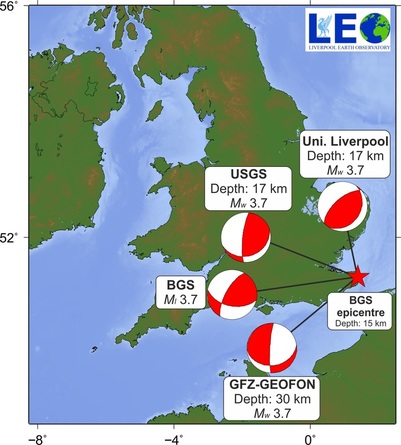
Map showing our moment tensor solution (Uni. Liverpool) compared with other published solutions.
|
Interpretation
|
The best-fitting moment tensor produces a focal mechanism which has oblique thrust faulting (i.e. a combination of slight horizontal and extensional motion) along a fault plane striking NW-SE and dipping to the northwest or a along a fault plane striking NW-SE and dipping shallowly to the SE.
The direction of maximum horizontal compression from this focal mechanism is northwest-southeast, consistent with focal mechanisms for other earthquakes in the UK. These directions are expected from plate motions, with compression from the south from the collision of Africa and Europe in the Mediterranean, and from the continued rifting of the Atlantic Ocean at the mid-Atlantic Ridge. |
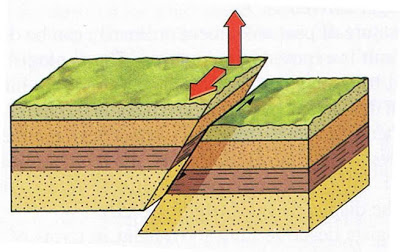
Schematic cartoon of oblique thrust faulting
|
Using this Solution
This moment tensor solution is publicly available and free-to-use under a Creative Commons license (CC-BY). However, credit must be given to the author when citing this work. Citation: Hicks, Stephen (2015): 22/05/15 M4.2 Kent earthquake - Moment Tensor solution. figshare. doi: http://dx.doi.org/10.6084/m9.figshare.1423441
References
Booth, D.C. 2010 UK 1-D regional velocity models by analysis of variance of P-wave travel times from local earthquakes. J. Seismol., 14 (2). 197-207. doi: 10.1007/s10950-009-9160-4.
Miliorizos, M, Ruffell, A and M. Brooks. 2006. Variscan structure of the the inner Bristol Channel, UK. J. Geol. Soc., 161, 31-44. doi: 10.1144/0016-764903-035.
Sokos E.N. and Zahradnik, J. 2008 ISOLA a Fortran code and a Matlab GUI to perform multiple-point source inversion of seismic data, Computers & Geosciences, 34 (8), 967-977. doi: 10.1016/j.cageo.2007.07.005.
Tomlinson, J.P, Denton, P., Magure, P.K.H., Booth, D.C. 2006. Analysis of the crustal velocity structure of the British Isles using teleseismic receiver functions. Geophys. J. Int., 167, 223-237. doi: 10.111/j.1365-246X.2006.03044.
Miliorizos, M, Ruffell, A and M. Brooks. 2006. Variscan structure of the the inner Bristol Channel, UK. J. Geol. Soc., 161, 31-44. doi: 10.1144/0016-764903-035.
Sokos E.N. and Zahradnik, J. 2008 ISOLA a Fortran code and a Matlab GUI to perform multiple-point source inversion of seismic data, Computers & Geosciences, 34 (8), 967-977. doi: 10.1016/j.cageo.2007.07.005.
Tomlinson, J.P, Denton, P., Magure, P.K.H., Booth, D.C. 2006. Analysis of the crustal velocity structure of the British Isles using teleseismic receiver functions. Geophys. J. Int., 167, 223-237. doi: 10.111/j.1365-246X.2006.03044.
