
Looking into a Megathrust Earthquake Rupture Zone
On 27 March 2010, a magnitude 8.8 earthquake struck the coast of central Chile - the 6th largest earthquake ever recorded. This earthquake occurred in the South American subduction zone, one of the most seismically active regions on the planet. Similar earthquakes occur around the Pacific Ring of Fire and are important to study because their large size can generate shaking-induced damage at the surface and large tsunami waves.
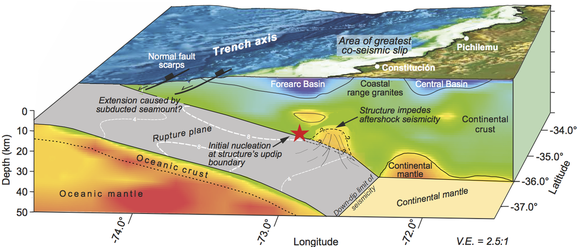
By using aftershocks that followed the earthquake, our objective was to study the internal structure of the rupture zone. This allows us to understand the physical properties along the fault and may yield important insights into what controls such large earthquakes.
By using aftershocks that followed the earthquake, our objective was to study the internal structure of the rupture zone. This allows us to understand the physical properties along the fault and may yield important insights into what controls such large earthquakes.
Phase 1: Rapid Seismometer Deployment
|
Following the quake in Chile, there was a combined international effort to deploy seismometers in the rupture area. These instruments measure the ground vibrations from aftershock earthquakes.
The University of Liverpool was one of the many institutions involved in the deployment. I was lucky enough to take part in the final stages of this deployment. The deployment was made in collaboration with: Universidad de Concepción, Universidad de Chile, IRIS (US), CNRS-INSU (France), GFZ (Germany). The station map can be found on the IRIS website. Information on downloading data can be found here. The lessons learnt from the deployment are summarised in this recent article published in EOS: Advancing Subduction Zone Science After a Big Quake. |
|
Phase 2: Preliminary velocity model
The first aim of my research was to understand the first-order subsurface structure of the subduction zone in the Maule region. To do this we used automatic analysis of recordings from aftershocks at the onshore seismic stations.
Publications: Hicks, S.P., Rietbrock, A., Haberland, C., Ryder, I.M.A., Simons, M. & A. Tassara (2012). The 2010 Mw 8.8 Maule, Chile earthquake: Nucleation and rupture controlled by a subducted topographic high, Geophys. Res. Lett., 39 (L19308). doi: 10.1029/2012GL053184 | view now | html | get pdf |
International collaborators: Mark Simons (Caltech), Christian Haberland (GFZ), Andrés Tassara (Universidad de Concepción), Christian Haberland (GFZ).
Publications: Hicks, S.P., Rietbrock, A., Haberland, C., Ryder, I.M.A., Simons, M. & A. Tassara (2012). The 2010 Mw 8.8 Maule, Chile earthquake: Nucleation and rupture controlled by a subducted topographic high, Geophys. Res. Lett., 39 (L19308). doi: 10.1029/2012GL053184 | view now | html | get pdf |
International collaborators: Mark Simons (Caltech), Christian Haberland (GFZ), Andrés Tassara (Universidad de Concepción), Christian Haberland (GFZ).
Phase 3: High-resolution velocity model incorporating offshore data
International collaborators: Chao-Shing Lee (National Taiwan Ocean University), Matthew Miller (Universidad de Concepción).
Publications: Hicks, S.P., Rietbrock, A., Ryder, I.M.A., Lee, C.S. & Miller, M (2014). Anatomy of a megathrust: the 2010 M8.8 Maule, Chile earthquake rupture zone imaged using seismic tomography, In Review at Earth Planet. Sci. Lett.
Publications: Hicks, S.P., Rietbrock, A., Ryder, I.M.A., Lee, C.S. & Miller, M (2014). Anatomy of a megathrust: the 2010 M8.8 Maule, Chile earthquake rupture zone imaged using seismic tomography, In Review at Earth Planet. Sci. Lett.
